Best AI Recipe Apps Compared: RecipLab, SideChef, DishGen, ChatGPT
Four recipe tools, four very different jobs. A side-by-side comparison of RecipLab, SideChef, DishGen, and ChatGPT — what each does well and where each falls apart.
Best AI Recipe Apps Compared: RecipLab, SideChef, DishGen, ChatGPT
You opened the App Store, typed “AI recipes”, and the results are a wall of apps with the same screenshot. You want one that works for you. The honest answer is that “best” depends entirely on how you start cooking — from a photo, from a craving, from a video, or from a meal plan. Here is a side-by-side that respects those differences.
The right question is not which app is best
It is which app fits your starting point. Recipe apps cluster into four shapes:
- Library apps index human-written recipes and let you search. SideChef and Mealime live here.
- Text-prompt generators turn a sentence into a recipe. DishGen and most general chatbots live here.
- Photo and video generators read an image of your fridge or a TikTok clip and rebuild a recipe from it. RecipLab is the focused tool in this lane.
- General assistants (ChatGPT, Gemini, Claude) do all of the above approximately and none of it natively.
Comparing across shapes by feature count is misleading. A library app will always have “more recipes” than a generator. A generator will always have “more flexibility” than a library. The question is which shape fits your week.
SideChef — the curated library with smart kitchens attached
SideChef has been building a hand-tested recipe library for over a decade. It pairs each recipe with step-by-step video, voice-guided cooking, and integrations with smart appliances (Samsung ovens, smart scales, voice assistants).
Strengths: scale of vetted recipes, polished cooking-mode interface, household features (meal plans, grocery lists), brand partnerships with appliances.
Weaknesses: not designed for “I have these random ingredients”. The AI features are layered on top of the library, not at the core. The app is heavy and the experience is geared to people who plan ahead, not to last-minute weeknights.
Best for: people who plan their meals on Sunday and use the same kitchen rituals each week.
DishGen — the focused text-to-recipe generator
DishGen is what RecipLab would be if it only accepted text. Type a prompt — dietary restrictions, ingredients on hand, cuisine, serving size — and it returns a structured recipe.
Strengths: simple interface, fast text-to-recipe flow, decent dietary handling, clear structured output.
Weaknesses: no photo input, no video parsing, no URL ingestion. Mobile experience is web-wrapped, not native. If your starting point is anything other than a typed sentence, DishGen does not help.
Best for: people who already know what they have and just want a recipe written for them in seconds.
ChatGPT (and Gemini, Claude) — general-purpose assistants
ChatGPT handles recipe prompts well because it has read most cookbooks ever digitized. Modern versions also accept photos.
Strengths: free or cheap, conversational, handles edits and follow-up questions (“make it spicier”), accepts photos in paid tiers.
Weaknesses: no recipe-specific UX. The output is prose, not a structured ingredient list with quantities you can scan while cooking. No way to save, organize, or re-open recipes a week later without copy-pasting. Photo handling for ingredients exists but is calibrated for general images, not optimised for kitchen lighting and clutter.
Best for: occasional one-off prompts where you do not need to come back to the recipe later.
RecipLab — photo and video as primary inputs
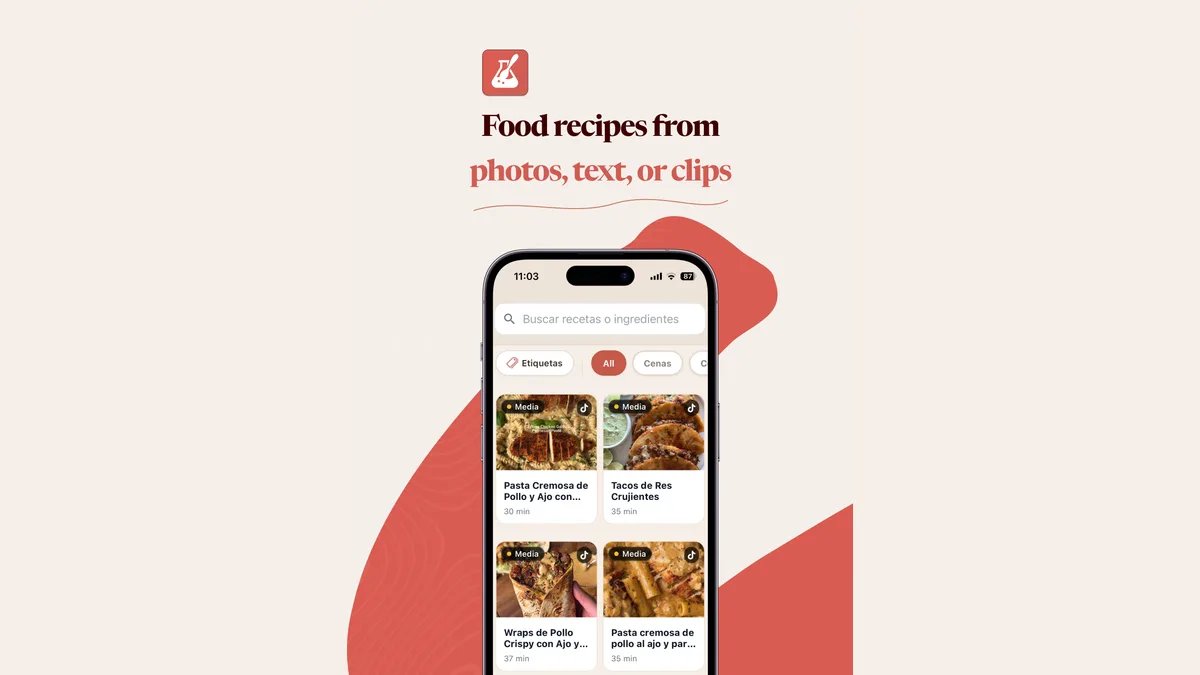
RecipLab is built around three inputs: a photo of ingredients, a typed prompt, or a TikTok / Reels / YouTube Shorts URL. Each input flows into a structured recipe — ingredients with quantities, steps in order, timings normalised, units converted.
Strengths: photo-to-recipe is the default flow, video URL ingestion (with both audio transcription and frame sampling for on-screen quantities), mobile-first interface, structured output you can scan one-handed.
Weaknesses: smaller library of curated recipes than SideChef — the model is generative, not browsing. No smart-kitchen integrations yet. Less recognised brand than the long-running incumbents.
Best for: people who cook from what is already in the fridge, save TikTok cooking videos but rarely cook them, or want to break out of the recipe-search-then-shop loop.
At a glance
| Capability | SideChef | DishGen | ChatGPT | RecipLab |
|---|---|---|---|---|
| Photo of ingredients to recipe | partial | no | partial | yes (native) |
| Text prompt to recipe | yes | yes | yes | yes |
| Video URL to structured recipe | no | no | no | yes |
| Recipe URL to cleaned-up recipe | no | no | partial | yes |
| Library of curated recipes | huge | small | none | small |
| Mobile-first interface | yes | partial | partial | yes |
| Save and re-open recipes | yes | yes | manual | yes |
| Smart-kitchen integration | yes | no | no | not yet |
The grid is more useful than any single ranking. If three rows in the column matter to you, that is your app.
Pick by use case
- You plan weekly menus and cook from a list: SideChef.
- You type “a quick X with Y” and want a recipe instantly: DishGen or ChatGPT.
- You start from a photo of the fridge: RecipLab.
- You save TikTok cooking videos and never cook them: RecipLab.
- You want one tool for occasional questions and don’t mind the format: ChatGPT.
What the comparison hides
Every app has a different idea of what counts as “a recipe”. SideChef’s recipes are human-written and tested. DishGen’s are model-generated and largely unverified. ChatGPT’s are model-generated, often from training data that has aged. RecipLab’s are model-generated but anchored to your inputs, with confidence flags on quantities the model had to estimate.
That last detail matters more than feature lists. A recipe that admits “oven temperature not specified in source — suggested: 200°C” gives you somewhere to push back. A recipe that confidently invents a quantity does not.
Try RecipLab when your starting point is a photo, a video, or “what do I have right now”.